

The earliest manifestations of Paul Gustave Doré’s abilities must have been a wonderful thing to watch. Born almost 200 years ago in Strasbourg (then Alsace) in 1832, he seemed ready immediately to draw, to train himself. By age 5, the toddler was an artistic prodigy, scratching out drawings that were mature beyond his years. By 12, he was carving stone. At 15, Doré began his stellar career as a caricaturist for the French paper Le journal pour Rire. He went on to create over 10,000 illustrations and, at the height of his career, he employed some 40 men to etch his drawings onto wooden printing blocks.

1832-1883
If a book was popular, Doré illustrated it; the works of Byron, the Bible, Edgar Allan Poe, Cervantes, Coleridge, Milton, Tennyson and Dante’s Divine Comedy, he drew them all and many, many other works of the day besides. If you read a popular book in the mid-1800s, Doré helped you visualise.
To feed growing international demand, his more popular works were duplicated (using the very latest electrotype technology) onto steel plates and pumped out relentlessly. The in-demand artist featured regularly in the The Illustrated London News and was signed by a British publisher on an annual contract which earned him £10,000 a year – a huge sum at the time.


Despite never having trained formally in a prestigious Parisian academy, Doré had no problem producing many critically well-received and publicly successful paintings. He also had some success as a sculptor. Now all but forgotten, he was one of the most prolific and successful book illustrators of the late 19th century, a time when his exuberant and bizarre fantasies that conjured up epic dreamlike scenes were “hypnotizing the widest public ever captured by a major illustrator”. His work was widely emulated too, by more formally trained Romantic academy artists. Even Vincent van Gogh painted a version of one of his illustrations.


after passing the rock of the Demons, Dante and Virgil enter the Infernal city of Dis. Farinata Degli Uberti rises from the flames. Gustave Doré, unknown date.

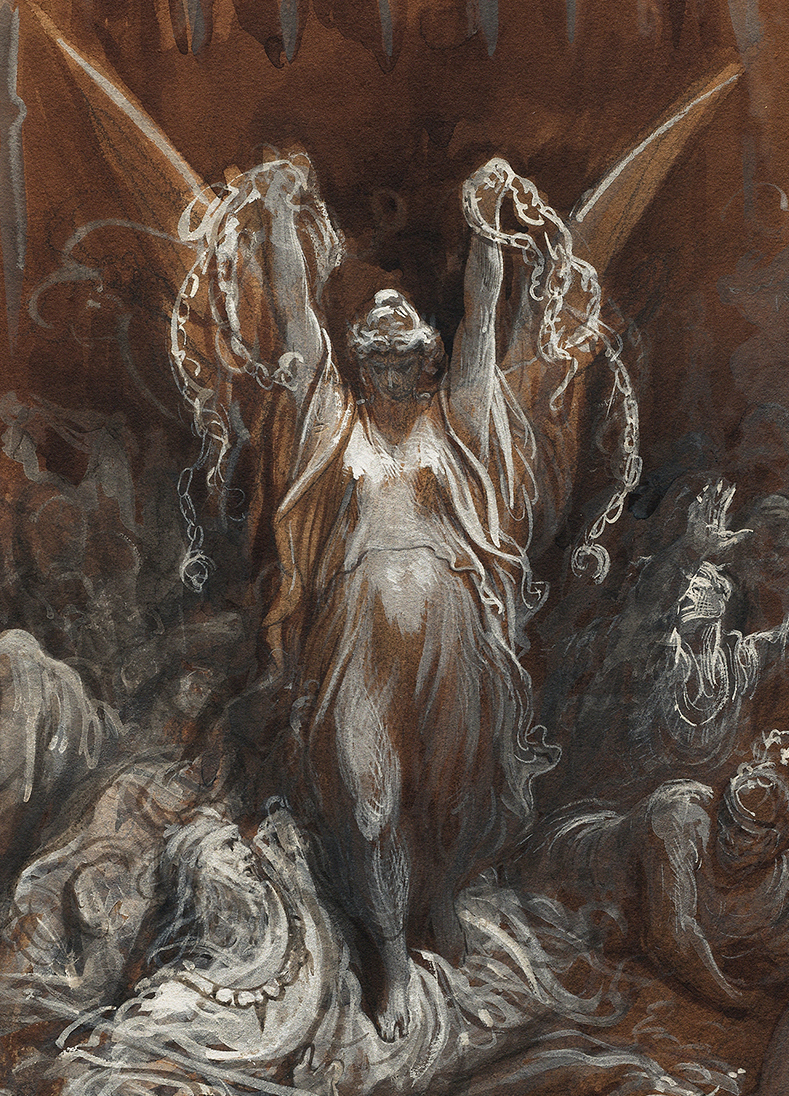
Design for an Illustration of Coleridge’s The Rime of the Ancient Mariner, about 1875


Doré never married and, after his father’s death in 1849, he lived with his mother. He was working on illustrations for an edition of Shakespeare’s plays in Paris when he died following a short illness. He was buried in the city’s Père Lachaise Cemetery.


In 1872 Doré published London: A Pilgrimage, with 180 wood engravings. It enjoyed commercial success, but was disliked by contemporary British critics, as it focussed on poverty stricken London. The Art Journal accused him of “inventing rather than copying,” and The Westminster Review claimed that “Doré gives us sketches in which the commonest, the vulgarest external features are set down”.


Vincent van Gogh, 1890
The work of Doré reached far and wide, even after his death. In France in 1888, Van Gogh suffered from an acute attack of mental ill health and from May 1889 to May 1890 was detained in Saint Paul’s Asylum in Saint-Rémy. The hospital’s director, Dr. Peillon, and Van Gogh’s brother, Theo, urged Vincent to paint to aid his recovery. Unable to go out to paint from life, he turned to copying other works, including photographs and engravings.
He chose Doré’s Newgate engraving and produced Prisoners’ Round (left), or rather a copy of it. He worked from a more distinct woodblock reproduction by Héliodore Pisan, he found in Katholieke Illustratie, a Dutch magazine.
In July 1890, a few months after painting his copy of Doré’s engraving, Van Gogh shot himself. Prisoners’ Round was one of the works placed around Van Gogh’s coffin before his funeral.
The artist’s friend, Émile Bernard described the painting as a metaphor for Van Gogh’s life:
“Convicts walking in a circle surrounded by high prison walls, a canvas inspired by Doré of a terrifying ferocity and which is also symbolic of his end. Wasn’t life like that for him, a high prison like this with such high walls – so high…and these people walking endlessly round this pit, weren’t they the poor artists, the poor damned souls walking past under the whip of Destiny?”


