

Red Flamingoes, c.1905–1909
Price range: $173.00 through $375.00
Flamingoes in a blaze of orange, their long legs dissolving into a dusky purple marsh. Abbott Thayer painted this study for his 1909 book on camouflage, convinced that even these birds were coloured to disappear.
Bold, warm and strangely calm, it lights up a room without shouting. Pair it with its white twin and watch the two flocks talk to each other.
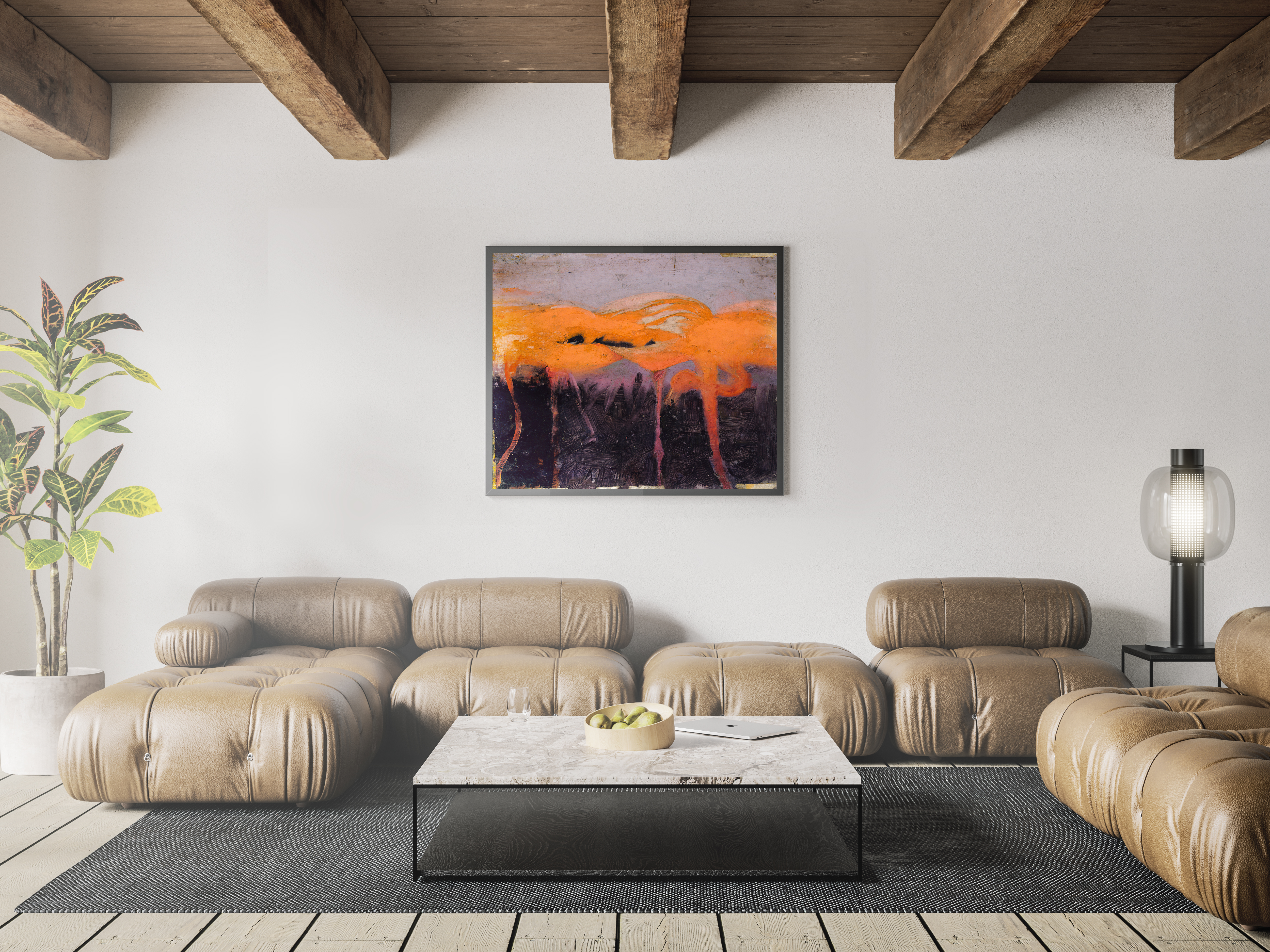
The print
Printed by theprintspace, the East London fine-art lab trusted by artists, galleries and museums. Each print is made to order on Hahnemühle German Etching, a heavyweight 310gsm mould-made paper with a slightly warm white tone and a soft, mottled texture, using archival pigment inks made to last for generations.
German Etching suits this study especially well. Its warm tone and textured surface hold the flaming oranges and soft violets richly, with the feel of paint rather than photograph.
A note on the surface: Thayer painted these studies quickly and surely, and every brushmark, drag and scratch of the original is reproduced faithfully. Up close they read almost as abstracts; from across a room the birds come and go, which was exactly his point.
Sizes available:
35×28cm, 14×11″, fine art print, open edition
50×40cm, 20×16″, fine art print, open edition
70×56cm, 28×22″, fine art print, open edition
Safe, tracked delivery guaranteed worldwide, with sustainable packaging.
The story
In 1909, the painter Abbott Handerson Thayer and his son Gerald published Concealing Coloration in the Animal Kingdom, arguing that an animal’s colouring, however eye-catching, works to hide it. Even bright pink flamingoes, they said, would vanish against a sky of the same colour at sunrise or sunset.
Here the birds themselves take centre stage, painted so that their colour and the colour of the sky behind them run together.
Not everyone was convinced. Theodore Roosevelt called the theory ludicrous and wrote a 112-page article against it; Thayer repeatedly invited him to his home in New Hampshire to see for himself, but Roosevelt never went. Part of Thayer’s idea, countershading, proved right and is still known as Thayer’s law. The studies he painted for the book are now in the Smithsonian American Art Museum.
You May Also Like

Peacock in the Woods, 1907
Abbott H. ThayerPrice range: $173.00 through $403.00Select options This product has multiple variants. The options may be chosen on the product page 
Girl in a White Kimono, 1894
$768.00Add to cart
Bashi-Bazouk, 1868–69
Jean-Léon GérômePrice range: $240.00 through $403.00Select options This product has multiple variants. The options may be chosen on the product page 
Cupid’s Hunting Fields, 1885
$826.00Add to cart